Fog is a very dangerous weather phenomenon. Generally speaking, it is a cloud that forms at ground level. It consists of tiny water droplets (sometimes frozen into crystals) suspended in the air, the same ones that make up clouds, and is formed as a result of a process called condensation.
How fog is formed
Air always contains a certain amount of water vapor. Warm air can “hold” more water vapor than cold air, and as the air cools its ability to hold water vapor decreases. If the air cools enough to reach its saturation point (also called the dew point, which is the temperature at which air must be cooled for it to become saturated with water vapor) it can no longer hold all the water vapor in its gaseous state.
It is at this point that excess water vapor transforms (or condenses) into tiny water droplets around microscopic particles suspended in the air, called condensation nuclei. These droplets, suspended near the ground, reduce visibility and form fog.
Common types of fog
Mists form in different places depending on how the cooling mechanism occurs.
Irradiation Fog: this is the most common and forms at night, especially with clear skies and little wind. The ground cools quickly by radiating heat, and in turn cools the air above to the dew point. It typically forms in valleys and plains, and dissipates in the morning as the sun warms the air.
Advection Fog: formed when warm, moist air flows horizontally over a much colder surface (such as land or cold sea), typical of coastal areas.
Evaporation Fog: formed when cold air passes over a warmer water surface (lakes, rivers) causing rapid evaporation and immediate condensation.
Orographic Fog: typical of mountain slopes when air forced up a mountain slope cools and moisture condenses.
Fog on the A24 and A25 Highways.
The A24 and A25 highways pass through inland areas of the Apennines, which are characterized by plateaus, valleys, and elevation differences that create ideal conditions for fog, especially at night and early morning, or in winter with thermal inversion.
All territories are subject to this weather condition, which reaches even to the outskirts of Rome, but there are some areas where it is more common to encounter banks of fog (often thick or with very reduced visibility):
Plains and Highlands: these are areas that favor radiation fog, as heat dissipates more easily and cold air tends to stagnate. In particular, along the A24 highway, the area of the Salto Plateau, between the Valle del Salto and Tornimparte / L’Aquila Ovest exits, is one of the most exposed, as is that of the A25 highway through Marsica, between the Torano and Pescina exits.
Inland Valleys and Hollows: valley floor sections, especially where humidity is highest (near waterways) or where cold air descends and accumulates, are also at risk. Staying on the A25 highway, the section through the Peligna Valley (for example, between Cocullo and Bussi/Popoli) or that of the A24 cutting through the L’Aquila basin may be affected, although in these areas the risk is often related to snow and ice in winter.
Mountain Passage Sections: In general, all highway sections that pass through high-altitude areas or are often shrouded in low clouds (which at ground level are considered fog) may have poor visibility.
More generally, special care is recommended in winter and midseason, especially in the highlands and inland valleys of Abruzzo and upper Lazio, especially before the sun manages to warm the air.

Driving safely in fog: the essential rules
To face even the densest fog banks with maximum peace of mind and for everyone’s safety, the suggestion is to follow a few rules ranging from driving tips to appropriate vehicle controls.
-
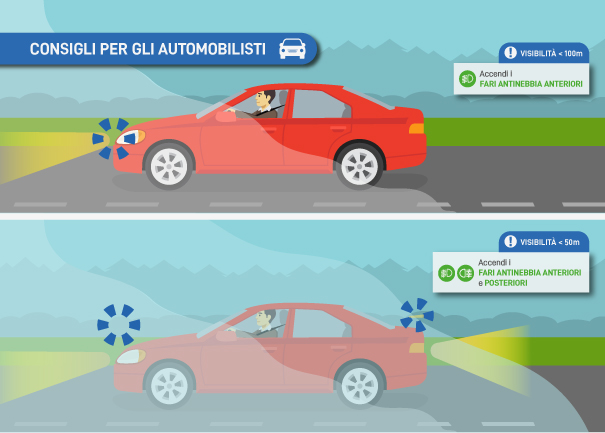
Turn on the fog lights (rear and front)
Always turn on the low beam headlights. If visibility drops below 100 meters, turn on the front fog lights. If visibility is less than 50 meters, also turn on the rear fog light (you only have one, it is very bright and orange/red).
NEVER use high beams! The light reflects off the water droplets in the fog and worsens visibility.
-
Slow down and increase the distance
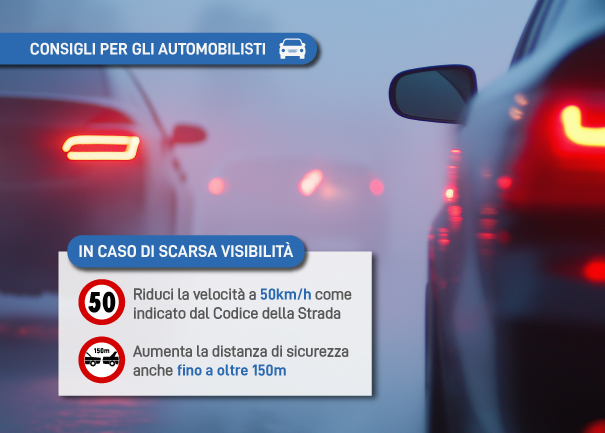
Reduce speed immediately. In dense fog, the law requires you to reduce the speed limit. The 50 km/h speed limit is not advice, but the maximum limit imposed by the Highway Code in heavy fog, even on highways. In any situation, the Highway Code (Art. 141) always requires speed to be adjusted so as to avoid any danger to safety taking into account road and traffic conditions.
When the fog is so thick that visibility is limited to a few dozen meters, containing the cruising speed as much as possible is the only solution that allows a stopping time compatible with the visibility space, preventing rear-end collisions, the most frequent accident on the highway in these conditions. This is why one must always remember to increase the safety distance from the vehicle in front, even to more than 150 meters, if necessary.
In case of fog, on highways such as the A24 and A25 you can refer to the Variable Message Signs (VMPs) and the information on these valuable media located along the sections.
-
Don’t rely on others but follow the strips
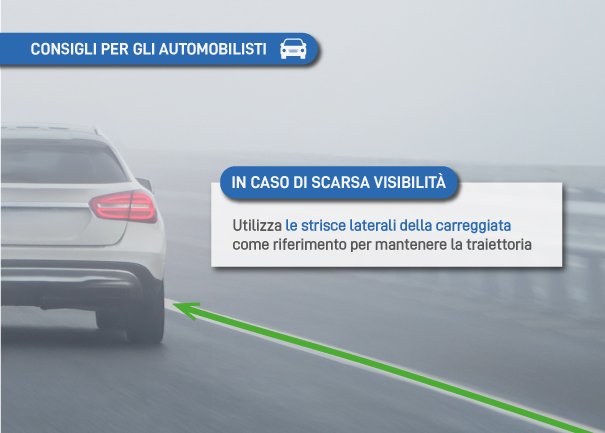
Never follow the rear lights of the vehicle in front blindly; it may veer off the road or slow down abruptly. Instead, use the side strips of the roadway (the white line on the right) as a reference to maintain your trajectory.
-
Avoid abrupt maneuvers
Steer and brake smoothly and gradually. Sudden maneuvers can cause skidding, especially if the asphalt is wet or icy.
-
Don’t stop on the highway
Stopping in the emergency lane can be extremely dangerous in low visibility conditions. Other vehicles may not see you.
When you can’t help but stop, look for a rest area, service area or exit, moving as far away from the roadway as possible and always activate the four arrows.
For the functionality of your vehicle:
-
Use air conditioning
Use air conditioning (even in winter) or the defrost function. This reduces humidity inside the passenger compartment and prevents the windows from fogging up.
-
Keep your windows clean
Cleanliness: Perfectly clean windows and headlights are essential. Dirt can reflect light from headlights, worsening visibility.
Windshield Washer Fluid: Make sure you have sufficient windshield washer fluid (preferably de-icer in winter) and wiper blades in good condition.
-
Check the efficiency of the headlights
Periodically check that all headlights (low beams, front fog lights, and especially the very powerful rear fog light) are working properly and are not covered with mud or dirt.
Fog lights: how to use them only when necessary, avoiding fines
The proper use of fog lights is governed by Article 153 of the Highway Code (Use of visual warning and illumination devices): it states that fog lights should be used only in heavy fog, mist, heavy rain, or snow. Article 153 stipulates that rear fog devices must be used in fog of less than 50m. Front fog lamps are also needed in all other cases of heavy fog, heavy rain, or snow.
The Highway Code is clear: fog lamps must be turned off as soon as visibility conditions improve. If they are used improperly, you risk fines and the deduction of driving license points.
In particular, the rear fog light is extremely bright (much brighter than a regular stop light) and can dazzle those following, creating a “red wall” effect that prevents proper assessment of distances and tires the eyes, increasing the risk of accidents.
When passing a fog bank, remember to immediately turn off the rear fog light and, if visibility is excellent (over 100 meters), turn off the front ones as well, leaving on only the low beams, which, remember, are mandatory on highways in all visibility conditions, even during the day.