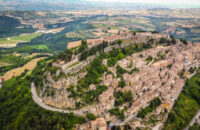
2026 will be a memorable year for L’Aquila: the city, wounded by the 2009 earthquake and the protagonist of a long reconstruction, has been chosen as the Italian Capital of Culture. A recognition that is not just an award, but a message of rebirth and pride for Abruzzo and all of Italy. The initiatives that will accompany this special year tell of a city that is once again a center of art, history and experimentation.
Andrea Pazienza: the genius of comics at MAXXI L’Aquila
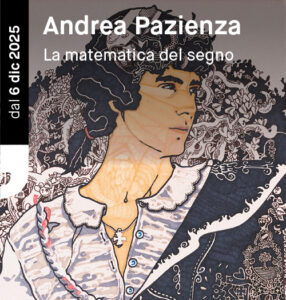 The first major event is already a reality: from December 6, 2025, the MAXXI L’Aquila hosts the exhibition dedicated to Andrea Pazienza (1956-1988), on the 70th anniversary of his birth. Pazienza, a multifaceted and revolutionary artist, marked the history of Italian comics with iconic characters such as Zanardi and Pompeo, works that caustically chronicled Italy at the turn of the 1970s and 1980s.
The exhibition, curated by Stefano Piccoli, brings together more than 300 works, many of them previously unpublished: childhood drawings, ink drawings, watercolors, and marker compositions. Works that also testify to his deep connection with Abruzzo and Pescara, the city where the artist studied and took his first steps as a draftsman. After April 6, the last date of the exhibition at MAXXI, the exhibition will move to Rome, again along the A24 axis, with a different selection of works, creating an ideal bridge between two cities united by culture.
MuNDA’s return to the Spanish Fort.
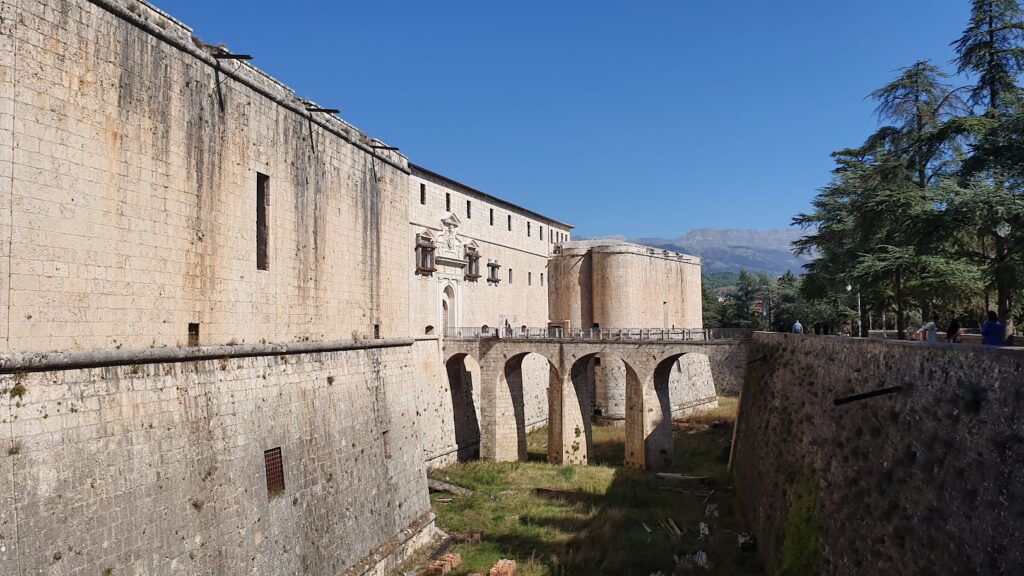
Another highly anticipated piece of news is the reopening of the National Museum of Abruzzo (MuNDA) in its historic home: the 16th-century Spanish Fort, closed since the 2009 earthquake. As of Dec. 2025, the public will be able to return to visit the permanent collections, which include works of sacred art, archaeological finds, and the famous Mammoth skeleton, L’Aquila’s identity symbol and a unique attraction for young and old alike.
Strada dei Parchi celebrates the Italian Capital of Culture
To accompany this extraordinary year, Strada dei Parchi has installed a large tourist sign on the A24, between the L ‘ Aquila East and L’Aquila West exits, visible in both directions. A tribute to the city and its symbols, inviting those traveling along the highway to stop and discover an area rich in history, nature and culture.
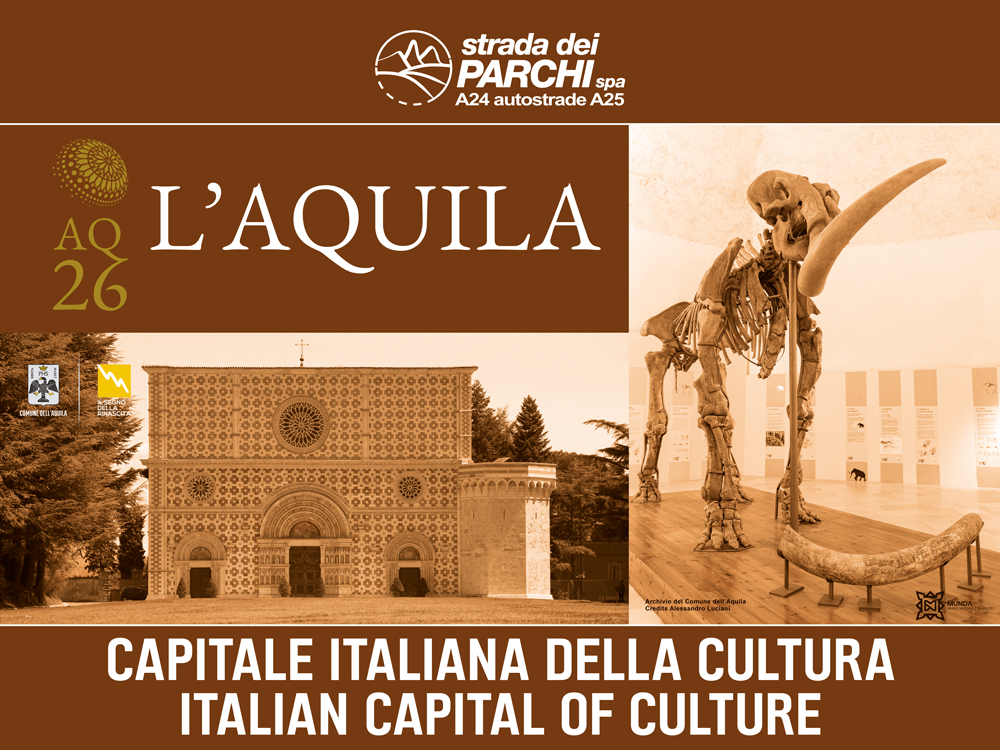
The Mammoth, found in 1954 in the L’Aquila basin, has become an icon of the city over the years, so much so that it was chosen as the protagonist of the large tourist sign wanted by Strada dei Parchi on the A24. The reopening of MuNDA is a tangible sign of the reconstruction and the desire to give back to the city its cultural places.
Next to the Mammoth, the facade of Santa Maria di Collemaggio, a masterpiece of Abruzzo Romanesque architecture and spiritual symbol of the city, stands out on the Strada dei Parchi sign. With its rose window and refined geometric pattern in pink and white stone, Collemaggio is the birthplace of the Perdonanza Celestiniana, a UNESCO heritage site, and where faith, art and identity are intertwined.
Appointment in L’Aquila next January 17, when the President of the Republic, Sergio Mattarella, will kick off the program of events with his visit. Over the next year, L’Aquila will be the site of 300 events, coming to be a national model of regeneration for inland areas with the goal of becoming a first national observatory to measure impacts, promoting a knowledge-based and participatory approach to revitalizing the territory and its centers…
2026 will not just be a calendar of exhibitions and openings, but a tale of values: the resilience of a community, the beauty of a unique artistic heritage, the power of culture as an engine of rebirth. L’Aquila returns to prominence, and Strada dei Parchi is proud to accompany this journey, because every kilometer of the A24 and A25 is part of a history that cultivates its tradition while boldly looking to the future.