
When the cold of January grips the Apennine landscapes in a vice and the mountains smell of wood, the nights of Abruzzo and Latium light up with fires, songs and blessings. It is the time of St. Anthony Abbot, the saint of fire and animals, who is celebrated in these lands with an ancient devotion: bonfires that purify, processions of horsemen, communal food and, everywhere, the blessing of animals. For this year we propose an ideal itinerary for those traveling along the A24 and A25, with stops in villages that, on Jan. 16-17 and on the weekend, renew a living heritage of rituals and traditions every year.
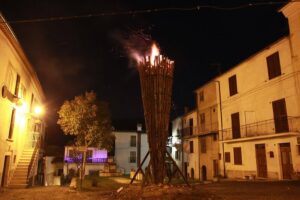
Collelongo (AQ) – Torcioni, cuttore and rescagnate basins.
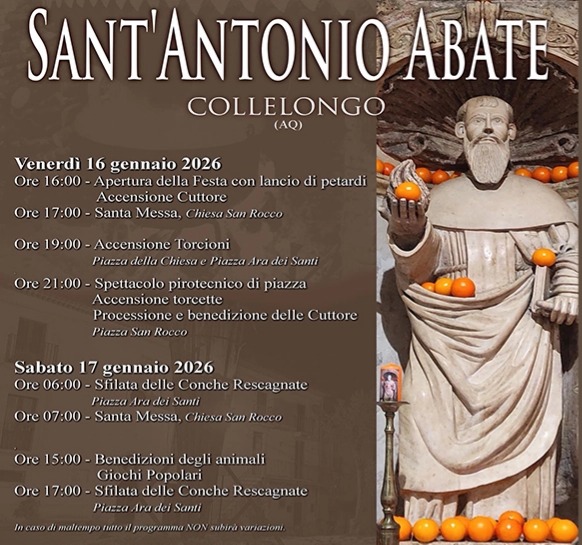 In Collelongo, Marsica, the festival is transformed into a ritual that has involved the entire village for more than four centuries. On the evening of January 16, torchons-largeoak flashlights more than five meters tall-are lit, while in some houses the cuttore, copper cauldrons in which chicharrones (corn) offered to patrons are boiled. The night is marked by songs and the blessing of the cuttore by the parish priest. At dawn on the 17th the rescagnate conches carried on the head by costumed girls parade; in the afternoon the blessing of the animals closes the festival. The Municipality of Collelongo is one of 22 signatories to the memorandum of understanding proposed by the Municipality of Agnone and aimed at creating a network of fire rites with the goal of aiming for Unesco recognition.
Villavallelonga (AQ) – Panarda, Pupazze and the beginning of Carnival
Not far from Collelongo, Panarda (votive banquet) is made on the night of the 16th, and on Jan. 17 the Pupazze-largepuppets-dance and then burn in the purifying rite that symbolically opens Carnival.
Collelongo and Villavallelonga can be reached from the A25 highway via the Avezzano exit.

Magliano de’Marsi (AQ) – Between devotion and conviviality (Jan. 18)
Magliano de’Marsi also renews the festival with Mass, blessing of animals and convivial moments (polenta, community initiatives).
Getting there: Magliano can be reached either from the appropriate exit on the A25 highway or from the A24 by exiting at Carsoli and continuing on the SS690.
Santa Maria del Ponte (Tione, AQ) – Fire and genuine flavors.
The enchanting medieval village of Santa Maria del Ponte, located halfway between L’Aquila and Sulmona in the Subequana Valley, celebrates the saint with a large bonfire, which can exceed 10 meters in height, and with a festival dense with devotion and conviviality, enriched by genuine traditional dishes: cotiche e fagioli, sagne e fagioli and barbecued sausages.
Directions: the charming hamlet of Tione degli Abruzzi can be reached either via the A24 highway, exiting at L’Aquila Est, or via the A25, from the Bussi/Popoli exit.
Scanno (AQ) – Le Sagne di Sant’Antonio Barone
In the beautiful village overlooking the lake, a local herding family prepares, in front of their home, several cauldrons filled with “sagne” seasoned with ricotta cheese. As soon as mass is over, in the nearby church of St. Anthony, the inhabitants go in procession, preceded by the parish priest, who blesses the cauldrons with food. Each devotee goes equipped with a small pot, which he fills with blessed “sagne” to take home.
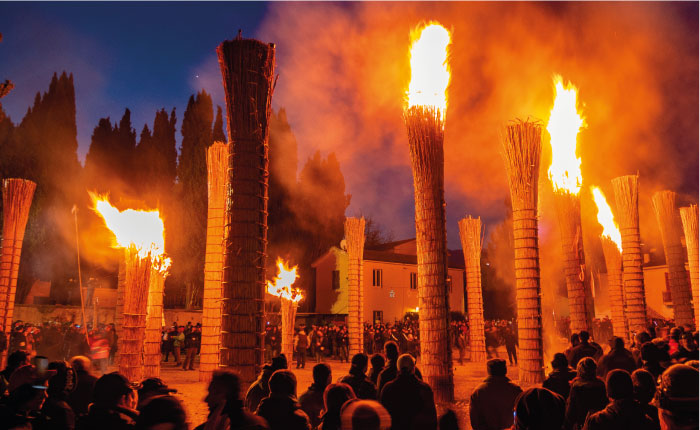
Fara Filiorum Petri (CH) – Le Farchie: the forest of fire January 16
The farchie are columns of reeds up to 10 meters high that the districts raise and light on the evening of Jan. 16, creating a “forest” of fire that evokes the “miracle” of 1799, when the invoked saint deterred an invasion of the country by the army of French revolutionaries. In 2026, the lighting is scheduled at 5 p.m. and, for the Jubilee Year, it takes place in the Colle Selva locality: a unique sight, with music, community and shared flavors.
How to get to Fara Filiorum Petri: from A25 exit Manoppello, continue on SS81 toward Fara Filiorum Petri.
San Valentino in Abruzzo Citeriore and Pescocostanzo (PE/AQ)
In San Valentino in Abruzzo Citeriore, Jan. 17 is a historic village festival; in Pescocostanzo, one of the most distinctive villages in the the blessing of animals and parish rituals enliven the center.
How to get there by the A25: exit at Alanno/Scafa, SP51 for San Valentino; for Pescocostanzo, exit at Pratola Peligna/Sulmona and continue SS17.
Pescosansonesco (PE) – Festival of St. Anthony and blessing (January 24)
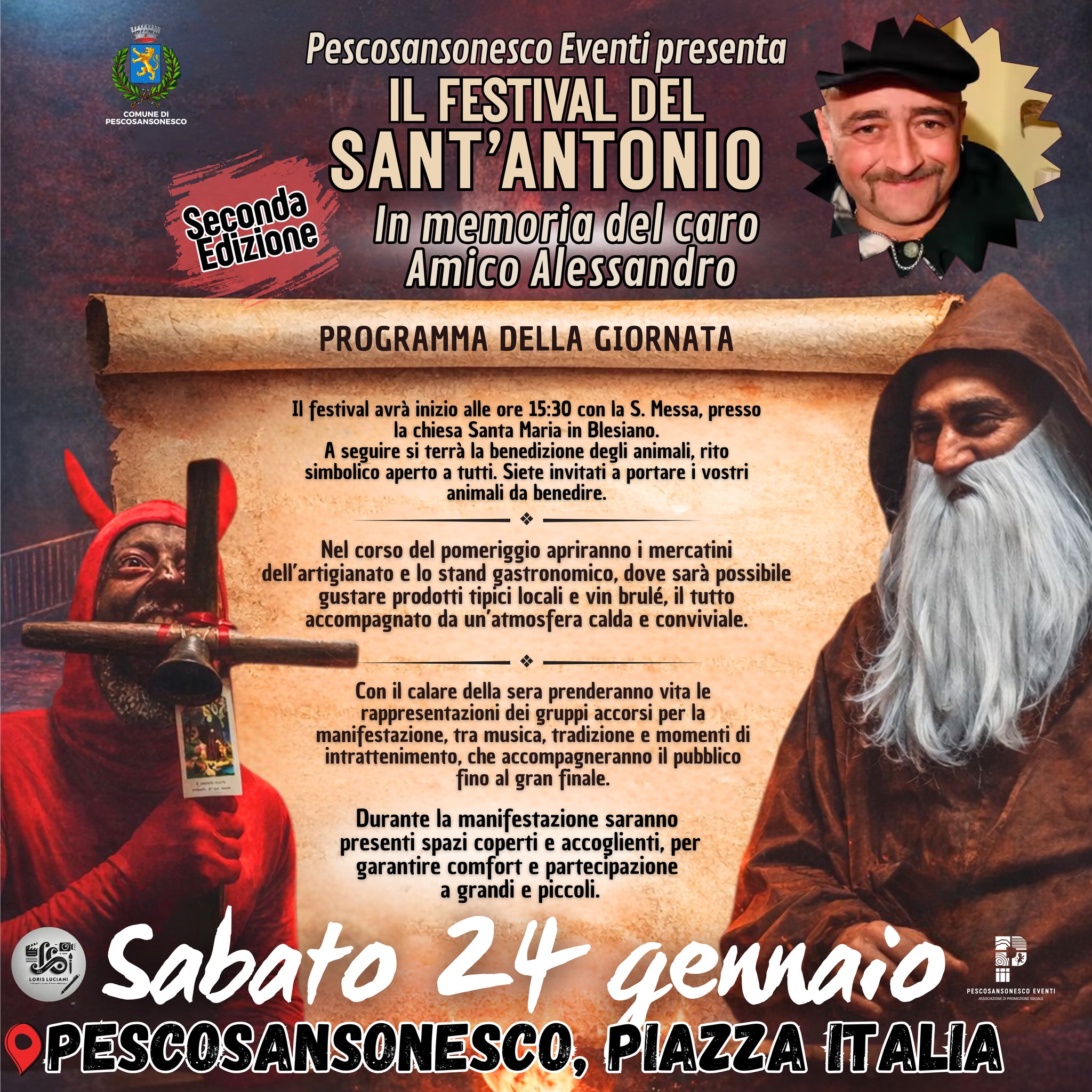 Some Abruzzo communities also plan events for the following weekend: in Pescosansonesco, the second edition of the Festival of St. Anthony is set for Saturday, January 24, 2026 . The festival features a performance by the Santantonieri, a historical group in the region that plays the “charrasco,” known in the village of Pescosansonesco as the sceta vaiasse (wake up cows).
How to get to Pescosansonesco: A25 exit Torre de’ Passeri-Casauria, SR153 toward Pescosansonesco.
Posta (RI) – Stanghe, fire and tastes
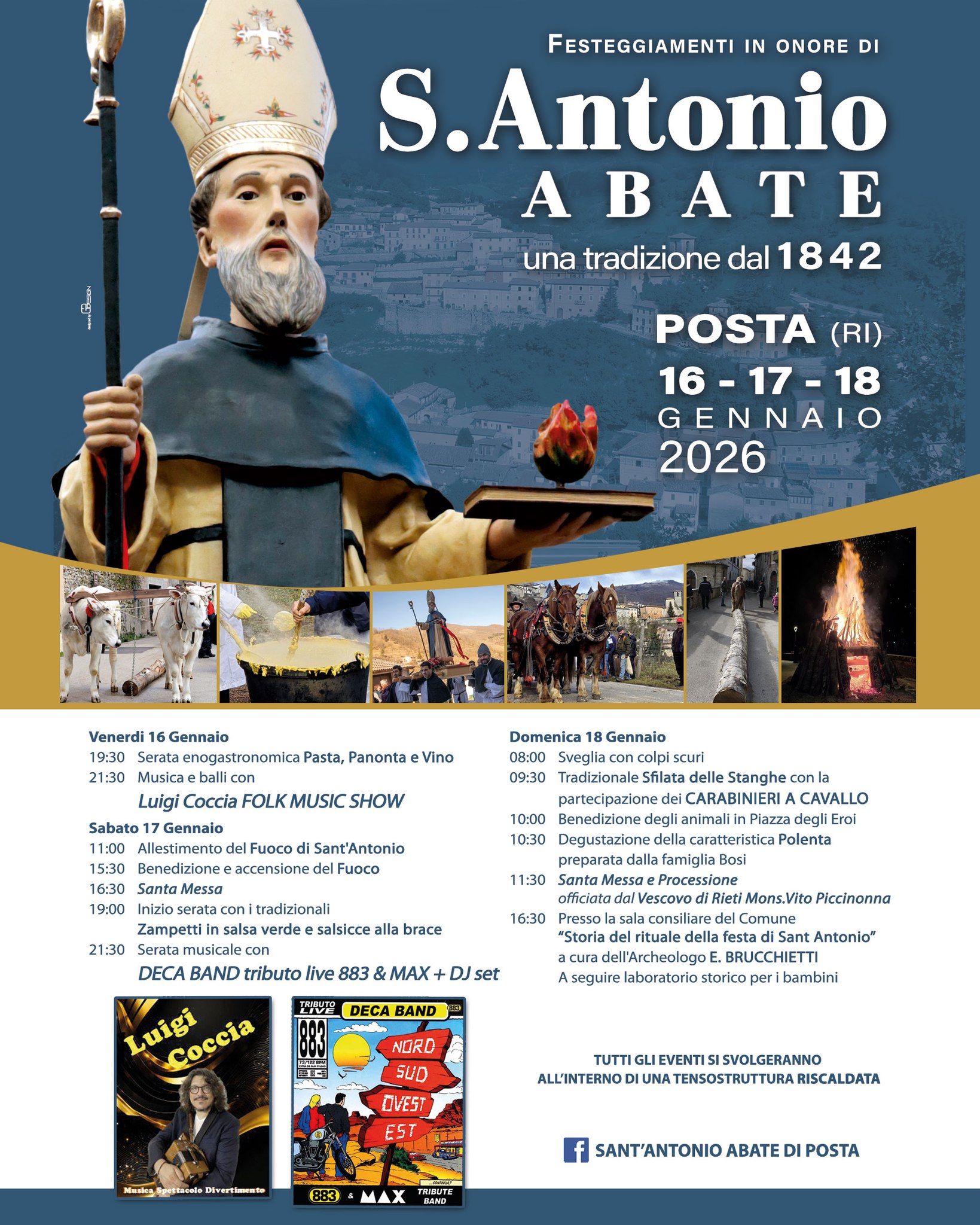 In the Reatino region, Posta renews the ancient rite of the stanghe: logs dragged in procession by oxen or horses, fire in the square, polenta and zampitti (pork shanks), with liturgies and blessing of the animals. The festival, linked to the 19th-century Confraternity, is centered around January 17 (or the following weekend).
How to reach Posta by the A24: exit Tornimparte/Campo Felice, continuing on the SS4 Salaria in the direction of Posta.
Carsoli and Tufo di Carsoli (AQ) – Knights, blessing and polentata (January 18)
Conveniently accessible from the A24 exit, Carsoli will hold a parade of horsemen, blessing of animals and a luncheon in the square on Sunday, Jan. 18; in Tufo di Carsoli, the 11 a.m. Mass will be followed by the blessing of animals and salt and a polentata offered by the Pro Loco.
Tivoli (RM) – Ride and blessing at the Bleso Amphitheater (Jan. 18)
Between faith and folklore, Tivoli gathers horsemen, band and citizens in a procession through the historic center to theBleso Amphitheater, where the blessing of the animals is held (Sunday, Jan. 18). The tradition is followed by thousands of people, with a strong community value, a short distance from the Tivoli exit of the A24 highway.
Rocca Priora (RM) – 175th edition: floats, Pane Benedetto and Scottone
In the Castelli Romani, the Feast of St. Anthony reaches its 175th edition in 2026: Triduum Jan. 14-16, solemn Mass on Saturday, Jan. 17, and on Sunday, Jan. 18, the popular Sagra dello Scottone with parade of floats and blessing of animals in Umberto I Square (with distribution of Pane Benedetto).
Velletri (RM) – A historical tradition of Lazio (January 17-18)
Off the A24-A25 route but historically central to Lazio, Velletri celebrates with parades of knights, torchlight procession in the medieval quarter, auction of the Standard, Joust at the Ring and Polenta Festival. It is one of the most structured festivals in the Roman area, supported by theMulattieri e Carrettieri University.
Rome – Sant’Eusebio all’Esquilino (Piazza Vittorio)
 On Jan. 17 at St. Eusebius, the blessing of animals is renewed: a centuries-old tradition of the Esquiline, now in a more collected form but still very much attended, with visits and cultural moments related to the church (among the oldest in Rome).
An invitation to discover an ancient tradition