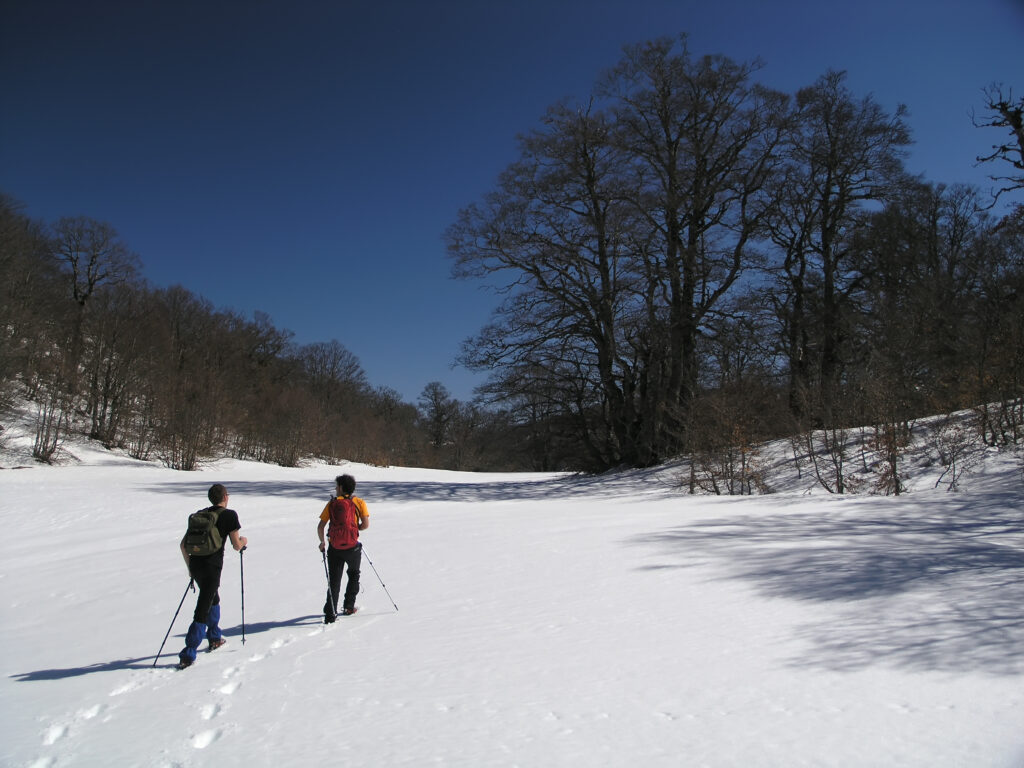
There are winter days when the mountains seem to ask only one thing: silence and light steps. Snowshoes were born precisely for this: snow “snowshoes” that keep you from sinking and allow you to walk where, otherwise, you would advance with difficulty. Today they are lighter and more stable than those of yesteryear, but the idea remains the same: to enter a white landscape without disturbing its calm.
Between February and March 2026 Lazio and Abruzzo offer a range of experiences from easy outings (for beginners) to longer routes, with the possibility of relying on guides and renting equipment on site if necessary. In general, for a guided snowshoe hike, the expense is in an affordable range, between 15 and 20 euros, which grows if services such as rentals and convivial moments in mountain huts are added.
Where snow starts an hour from Rome: Simbruini Mountains
If a quick getaway is the idea, the Simbruini Mountains are often the answer: beech forests, plateaus and ridges that in winter become a natural corridor of blue shadows and cold light. At Monte Livata (Subiaco), the winter program covers the span from Jan. 24 to March 31, 2026, with easy snowshoeing and sunset variants-a perfect way to “break the ice” with snowshoes without turning the experience into an endurance test.
Among the most frequently cited routes is the Campo dell’Osso – Monte Autore loop, often referred to as suitable even for non-extreme outings (weather permitting).
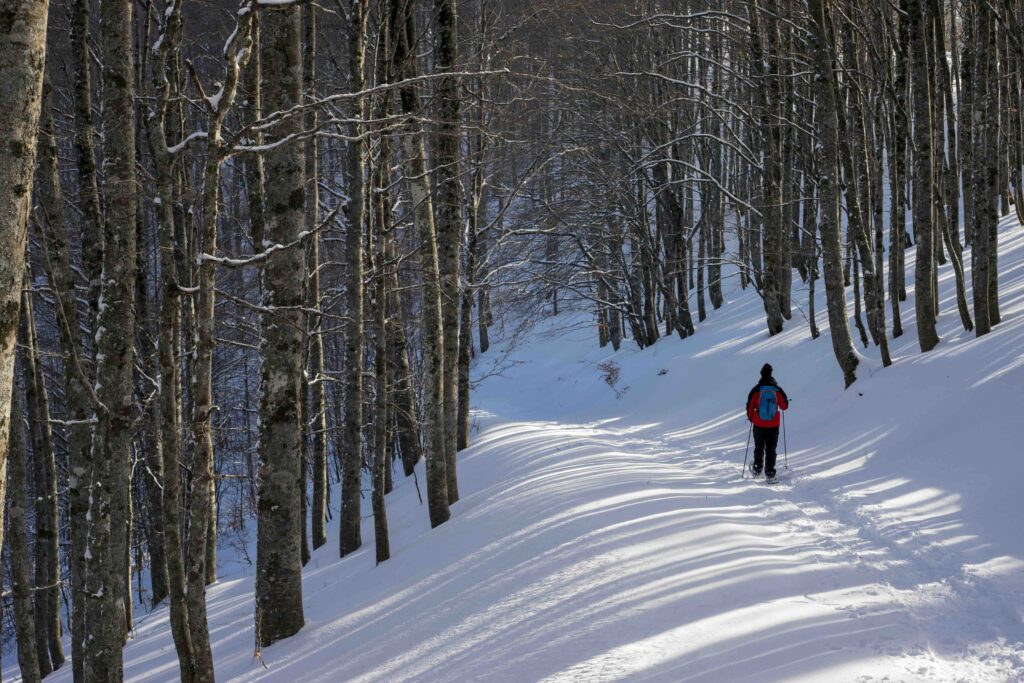
Walking between Lazio and Abruzzo and vice versa
A snowshoe hike across the Forca D’Acero Pass (1530 m), between Opi and San Donato Val di Comino , suitable for the whole family, where deer, wolves and roe deer can often be encountered, crossing forests in pristine landscapes. In the Abruzzo, Lazio and Molise National Park, snowshoeing becomes above all an exercise in mindfulness. Between Pescasseroli, Barrea up to Ortona dei Marsi you walk in protected environments, where the forest is the protagonist and the pace is naturally slower.
Winter trails traverse ancient beech forests and silent glades, often designed to be accessible and guided precisely to enhance the naturalistic aspect. Here the snow is not just a surface on which to walk, but a kind of white page on which to read traces, movements, invisible presences.
For those pursuing the more “naturalistic” aspect, the National Park is an almost obligatory choice. Specific outings such as snowshoeing in the Selva Moricento, linked to the UNESCO-recognized ancient beech forests, and shorter tours designed to take your first steps with snowshoes appear in the official 2026 calendar.
In the heart of the Apennines: Sirente-Velino and Campo Felice
When, on the other hand, you are looking for a “broader” horizon, where the snow seems to stretch into plains and valleys, the Sirente-Velino area offers very scenic itineraries. Campo Felice is one of the best known starting points: here you will find proposals designed also for families and more structured outings, with dates calendared at the height of the season.
And it is here that the imagery of “classic” snowshoeing also takes shape: the white plain, the entrance to the forest, the gradual ascent that gains altitude and views. Among the iconic destinations, Rifugio Sebastiani (2102 m) is often a satisfying achievement, because it combines walking, high altitude environment and the achievement of a “well-deserved” goal.
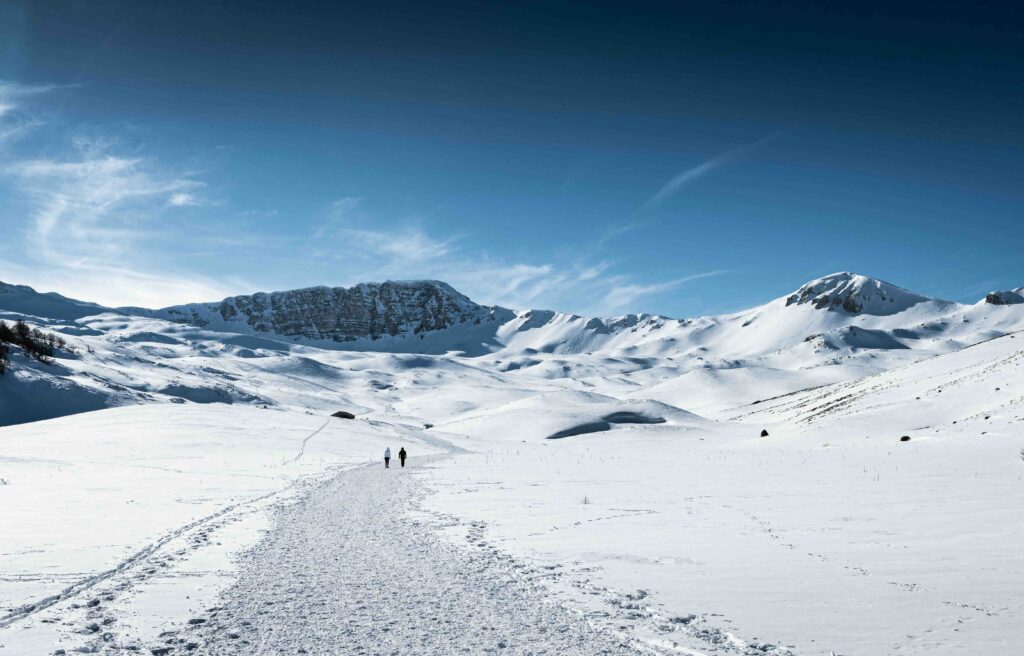
Gran Sasso: space, light and silence
On the Gran Sasso, snowshoeing changes face depending on the slope, but it always retains a feeling of breadth and freedom. From the L’Aquila side, the open spaces of Campo Imperatore dominate: soft trails, wide horizons, a light that seems to dilate in winter. It is a mountain that is not intimidating, even when walking on snow, and for this reason lends itself well to both first experiences and slow, contemplative outings.
The Teramo side, on the other hand, accompanies the visitor step by step inside beech forests and glades, with a natural progression that gradually leads to altitude gain. Here snowshoeing has a more collected pace, made up of woods, close silences and sudden overlooks of the great walls of the massif. For more challenging routes, start from Prati di Tivo to reach La Madonnina, following the trail or going up by cable car. From La Madonnina, the route crosses Passo delle Salette (2100 m) with a stop at Rifugio Carlo Franchetti (2433 m). Two different ways of experiencing the same mountain, both capable of restoring that rare feeling of balance between movement and landscape.
Maiella: when the mountain looks at the Adriatic
And then there is the Maiella, which in winter has a special character: more open, brighter, with certain belvederes that allow you to contemplate the blue of the sea surrounded by the white of the snow. The “Majella vista mare” proposals fall right here: these are snowshoeing trips built to combine snow and horizon, often with sunset variations and convivial moments.
In February-March, the Maiella offers a range of different formulas: from the more basic guided walk to packages that include rentals and polenta lunch.
And if you want a timely and technical reference, the Maielletta/Passo Lanciano is one of the areas where half-day loop trails are described with precise directions on equipment and difficulty.
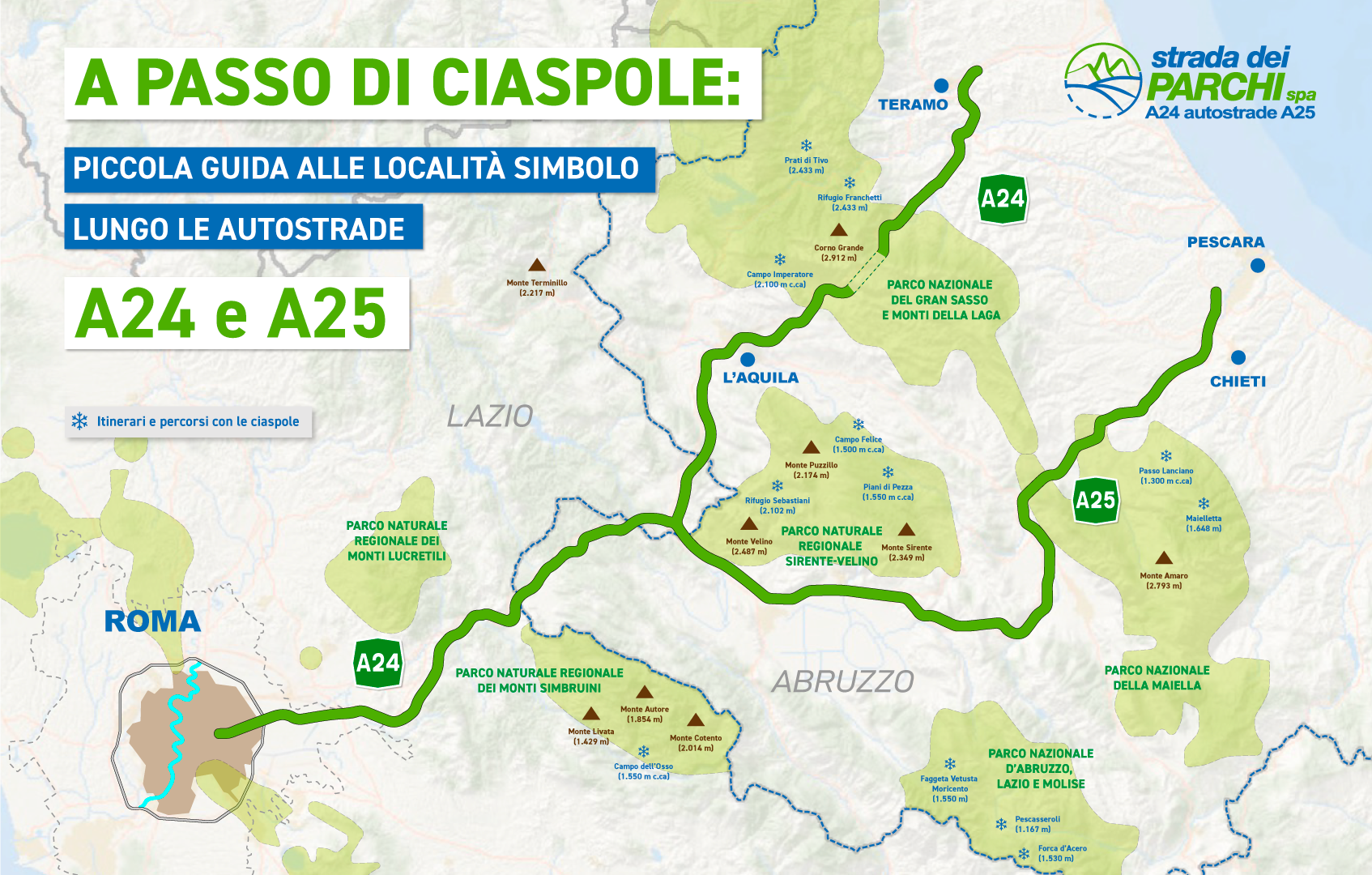
Getting there by the A24 and A25 highways
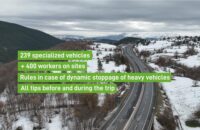
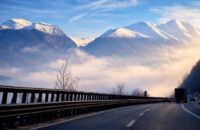
With Strada dei Parchi, be it Maiella, Gran Sasso, Sirente-Velino or Simbruini Mountains, all destinations are within driving distance.
The A24 is the natural route from Rome that connects the Simbruini and Lucretili Mountains (Vicovaro/Mandela, Carsoli), and then penetrates into the areas of the Sirente-Velino massif (Aielli/Celano, Magliano dei Marsi, Pescina) and Campo Felice (Tornimparte), toward the Gran Sasso Massif and the central Apennines linked to the great interior highlands.
The A25 is the most convenient corridor when the objective is the Maiella (from Bussi/Popoli to Alanno/Scafa) or the Abruzzo National Park , but it also connects the southern slope of the Sirente-Velino: from there one can then continue on the local road system to the excursion and visitor center meeting points.
Four practical tips (few, but good)
- Make reservations in advance, especially for the weekend, after checking the weather conditions.
- Don’t chase heroism: choose a route consistent with your training. The best snowshoeing is when you can look around, not just “hang in there.” (Many proposals clearly distinguish between easy and more challenging outings).
- Dress in layers and sock comfortably: waterproof boots, gloves and hat are not details. Those who organize snowshoeing often explicitly state equipment and limits, because in the snow, comfort is safety.
- Nighttime is magic… but it must be respected: sunset and return with the frontal have a unique charm, however, they require more attention and better cold management. If it is your first experience, better to do it guided