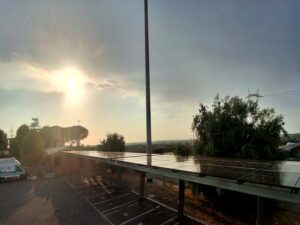
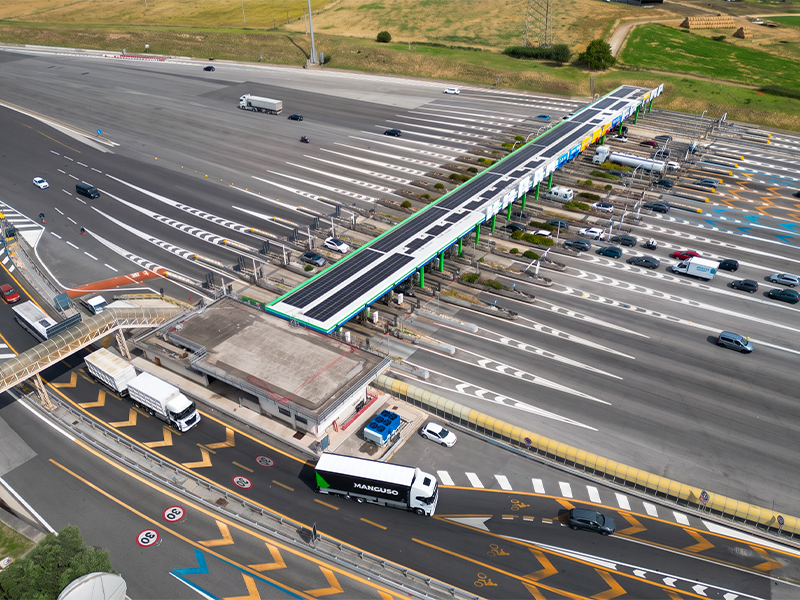
Since late August, 466 solar panels have been generating energy atop the canopies at the Barriera Roma Est interchange along the A24 highway. Not a single square meter of additional land was used: the modules are mounted on existing roofs. The project was commissioned by “strada dei parchi” and carried out by Renexia Services.
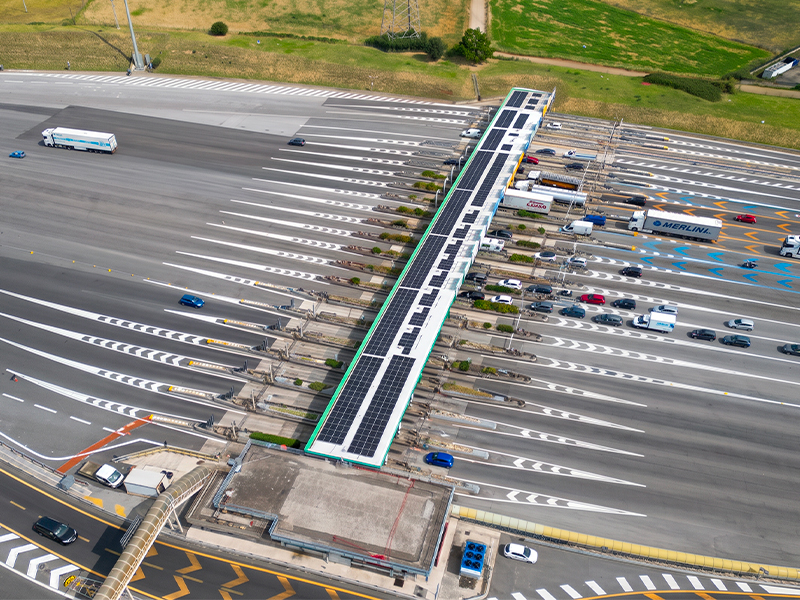
Anyone passing through the Roma Est toll plaza, at kilometer 8.1 of the A24, is unlikely to notice it. Yet, 466 solar panels have been installed above the toll plaza canopy (approximately 135 meters long and 12 meters wide) and above the smaller canopy covering the Lunghezza Station parking lot. Together, they generate 210 kilowatts of power, the equivalent of about 70 household systems. The panels rest on steel structures anchored to the existing roofs. Running beneath them are cables, electrical panels, and inverters—the devices that convert the direct current produced by the sun into electricity usable by the toll plaza’s systems. No solar fields, no fenced-off land, no altered landscape.
Working at Height Above an Open Highway
“strada dei parchi” commissioned the project and carried out the preparatory civil engineering work. Renexia Services managed the project, coordinating the various phases and entrusting the turnkey construction to Essesolar; Infraengineering was responsible for construction management and safety coordination. Construction began on June 8, 2026, following approximately one month of design work. The system became operational on August 24, 2026: just over two and a half months of actual work on a highway toll plaza that remained open throughout the project. This is the least visible and perhaps most delicate aspect of the entire project: installing panels above an operational toll plaza means working several meters above the ground, with approximately 40,000 vehicles per direction passing under the barrier every day and live electrical components present during the final stages. For this reason as well, a detailed Safety and Coordination Plan guided every phase of the project—from site inspections to installation, from testing to operation—and was scrupulously followed by all technicians and workers involved.
Energy that stays where it’s produced
Currently, the plant operates “off-grid”: this means that it is not yet connected to the national power grid and that all the energy it produces is consumed on-site. It powers the lighting, toll collection systems, and the technological and monitoring equipment for the barrier and station areas, which operate 24 hours a day. There is a simple logic behind this configuration: generating energy exactly where it’s needed. The fewer kilometers the electricity travels, the less is lost along the way, and the more predictable the energy costs become for an infrastructure that never stops.
Why a Shed Is Worth as Much as a Plot of Land
The decision to use overpasses instead of ground-level areas is no accident. Highways have large, existing surfaces that are already built, paved or sealed, connected to the power grid, and maintained by staff. These are locations where a solar power plant can be installed without placing any new demands on the local area. This is a point that touches on the entire Italian debate on renewables: the recurring question is not so much whether to produce clean energy, but where. Every canopy, every open space, every service roof used in this way is a piece of the energy transition that does not compete with agriculture or the landscape.
A first step, not an isolated incident
Roma Est is a limited-scope project, but the logic behind it can be replicated. Along the A24 and A25 highways, there are other canopies, plazas, and service buildings with similar characteristics; for each one, the assessment focuses on solar exposure, the structure’s ability to support the additional weight, and nearby electricity consumption. On a national scale, according to various industry estimates, the total area of highway-related structures—overpasses, service areas, and sound barriers—could accommodate several gigawatts of renewable power. This is a different way of looking at transportation infrastructure than usual: no longer just major energy consumers, but also places where energy is produced, integrating sustainability into the day-to-day management of the network rather than treating it as a separate issue.
Sustainability as a Management Principle
For “strada dei parchi”, environmental consideration goes beyond individual demonstration projects; it is an integral part of the criteria used to plan maintenance and renovate the network. This approach translates into consistent decisions: prioritizing existing infrastructure over new developments, reducing energy consumption before replacing energy sources, evaluating the full life cycle of facilities—from installation to disposal of components—and designing systems from the outset to ensure they are easy to maintain. Roma Est meets all four of these criteria simultaneously: this is why it serves as a benchmark for a sustainability strategy applied to highway mobility.
Frequently Asked Questions
How much energy does a 210-kW plant produce?
In central Italy, a system of this size produces approximately 250,000–280,000 kWh per year, which is roughly equivalent to the electricity consumption of about 100 households. This figure varies depending on the amount of sunlight available, the angle of the panels, and shading.
What does it mean for a system to operate “off-grid”?
It is not connected to the national power grid: the energy produced is consumed entirely on-site and cannot be fed into the grid or sold.
Can solar panels be installed on a bus shelter or an existing parking structure?
Yes, provided that the structure can support the additional weight—a technical inspection is required—and that the necessary building permits, any required landscape authorizations, and the connection application with the utility provider are obtained.
Are the panels on the canopies resistant to wind, snow, and hail?
Support structures are designed in accordance with technical building codes, which take into account wind, snow, and site-specific conditions. The modules are certified to withstand hail impact.
Do the signs on the highway blind drivers?
No. On rooftops, the modules have a low angle of inclination and surfaces treated to minimize glare, so they do not interfere with the visibility of passersby.
How long does a solar power system last?
The expected service life is 25–30 years. Periodic maintenance is required—including inspection of cables and connections, cleaning of surfaces, and electrical checks—and inverters are usually replaced halfway through the system’s service life.