For over seven centuries, at the end of August, L’Aquila has been renewing one of the most defining traditions in its history: the Perdonanza Celestiniana, the celebration commemorating the Bull of Pardon granted in 1294 by Pope Celestine V. An event with roots in the Middle Ages that continues to resonate today with a universal message of peace, reconciliation, and hospitality. This year, the anniversary takes on an even more special significance because it is part of the calendar of events for L’Aquila, Italian Capital of Culture 2026, offering the capital of Abruzzo an important national and international showcase.
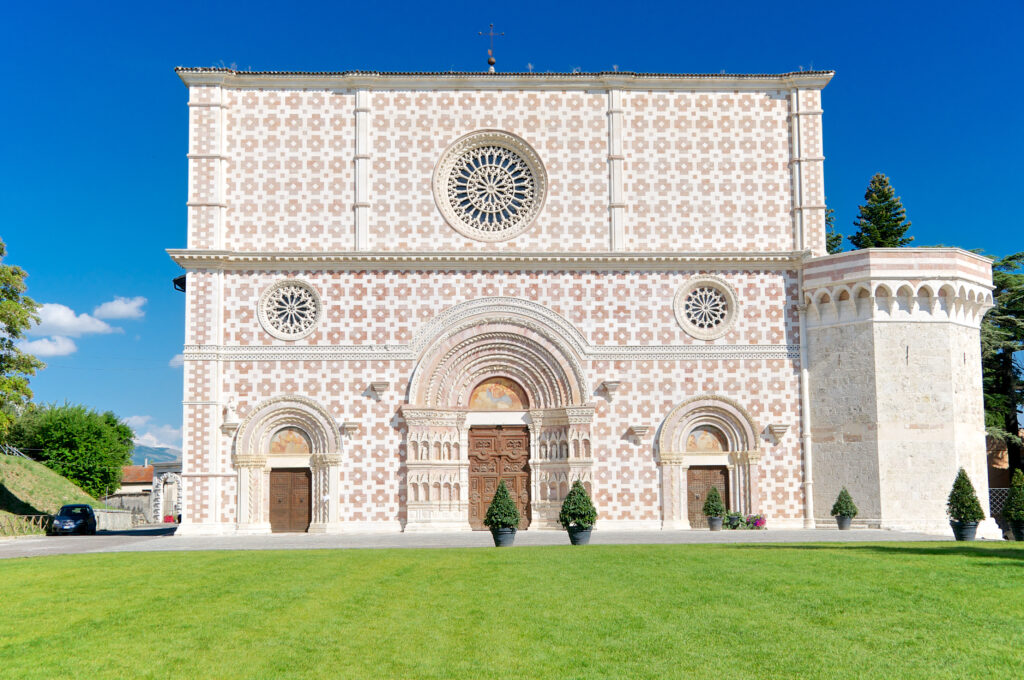
The Perdonanza, now in its 732nd edition, commemorates the act by which Celestine V granted a plenary indulgence to anyone who, having repented and confessed, passed through the Holy Door of the Basilica of Santa Maria di Collemaggio between August 28 and 29. A revolutionary idea for its time, it is considered by many to be the first Jubilee in Christian history. Since 2019, the Perdonanza has also been recognized by UNESCO as an Intangible Cultural Heritage of Humanity.
During its year as Capital of Culture, the event features a particularly rich program that weaves together spirituality, history, entertainment, and public participation. From August 23 to 30, the historic center of L’Aquila will become a vast open-air stage, brought to life by concerts, theater, dance, cultural events, and moments of deep devotion. Kicking off the 2026 edition will be “La Forza del Perdono” (The Power of Forgiveness), a major event scheduled for August 23 at the foot of the Basilica of Collemaggio and broadcast in prime time on Rai 1—a first that will bring the message of forgiveness into the homes of millions of Italians. Among the announced guests are artists and leading figures from the worlds of culture and entertainment, including Gianni Morandi, Massimo Ranieri, Sal Da Vinci, Marco Masini, Simone Cristicchi, Laura Chiatti, Raoul Bova, and Giorgio Pasotti.
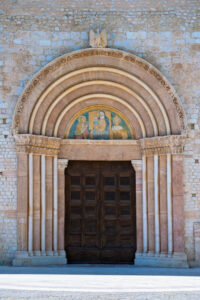 Alongside the artistic events, the festival features some of the most evocative traditional celebrations, from the “Fuoco del Morrone”—which arrives in L’Aquila from the hermitage of Sant’Onofrio—to the solemn “Corteo della Bolla,” culminating in the opening of the Holy Door of Collemaggio on August 28, the spiritual heart of the entire event. Among the most anticipated events are also the Dance Gala on the San Bernardino steps, Geolier’s concert, Alessandro Siani’s show, and Il Volo’s traditional “Concerto per L’Aquila.”
The tradition of forgiveness, however, does not end within the walls of L’Aquila. A few days earlier, in Atri, in the province of Teramo, on the Feast of the Assumption, another ancient Celestinian celebration takes place. Here too, according to a tradition that also dates back to 1294, the Holy Door of the Co-Cathedral Basilica of Santa Maria Assunta is opened—one of the few such doors in the world, aside from those in Rome and L’Aquila.
The Atri Forgiveness Festival kicks off with the Torch of Forgiveness, lit in the Basilica of Collemaggio and carried through the Teramo region to the ducal city, highlighting the historic bond between Atri and L’Aquila. The highlight is the historical procession on August 14 and the opening of the Holy Door, a ritual that draws the faithful, pilgrims, and visitors every year. The Holy Door will remain open for eight days, at the heart of the celebrations dedicated to the Assumption of Mary.
For those who wish to experience these two great Abruzzo traditions, access is particularly easy thanks to the “strada dei parchi” highway network. L’Aquila can be reached directly via two exits on the A24 highway, while Atri can be easily reached via both the A24 and the A25, as well as through connections to the Adriatic coast and the Teramo area. Two destinations, two centuries-old rituals, and a single message that transcends time: one of forgiveness, connection, and community.
Blending history, spirituality, and culture, the Perdonanza continues to be one of the most authentic and well-attended events of the Abruzzo summer, capturing the identity of the region and welcoming visitors from all over Italy along the roads that lead from the central Apennines to the coastal ranges.